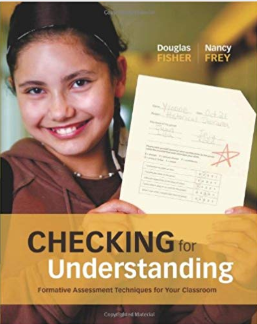
Douglas Fisher and Nancy Frey authored the book, Checking for Understanding (see two chapters). I am reading the first edition of the book. You can get either version online.
My Notes
- Checking for understanding should do the following:
- Align with enduring understandings (Wiggins & McTighe, 1998)
- Allow for differentiation (Tomlinson, 1999)
- Focus on gap analysis (Bennett et al., 2004)
- Lead to precise teaching (Fullan et al., 2006)
- Schmoker (2006) notes, “an enormous proportion of daily assessments are simply never assessed—formally or informally. For the majority of lessons, no evidence exists by which a teacher could gauge or report on how well students are learning essential standards”
- Using oral language to check for understanding
- The Initiate-Respond-Evaluate model of questioning dominates classroom discourse (see Cazden, 1988).
- In this model, the teacher asks a question, specific students are called on to answer the question, and the teacher evaluates the response.
- While this interaction requires oral language, it focuses on “guess what’s in the teacher’s head” or what the teacher already knows, not on critical thinking by the whole group. In addition, when one student is provided the opportunity to answer, the ability to check for understanding with the larger group is lost.
- Accountable talk is a framework for teaching students about discourse in order to enrich these interactions.
- accountable talk describes the agreements students and their teacher commit to as they engage in partner conversations.
- These include the following guidelines:
- Stay on topic.
- Use information that is accurate and appropriate for the topic.
- Think deeply about what the partner has to say.
- The Institute for Learning Web site (www.instituteforlearning.org) describes five indicators of accountable talk; we have added an example after each:
- Press for clarification and explanation: “Could you describe what you mean?”
- Require justifi cation of proposals and challenges: “Where did you fi nd that
- information?”
- Recognize and challenge misconceptions: “I don’t agree because . . .”
- Demand evidence for claims and arguments: “Can you give me an example?”
- Interpret and use each other’s statements: “David suggested . . .”
- Experts first seek to develop an understanding of problems, and this often involves thinking in terms of core concepts or big ideas. . . . Novices’ knowledge is much less likely to be organized around big ideas; they are more likely to approach problems by searching for correct formulas and pat answers that fi t their everyday intuitions (National Research Council, 2000).
- Value lineups help students to develop such in-depth knowledge by enabling them to explore core concepts and understand problems by having them first analyze their beliefs and then listen to the positions held by others.
- The value lineup is a structure for fostering peer discourse based on students’ opinions about an academic topic (Kagan, 1994).
- Students are asked to evaluate a statement and instructed to line up according to their degree of agreement or disagreement with the statement.
- After forming a single line, the queue is then folded in half so that the students who most strongly agreed and disagreed with one another are now face to face.
- Students then discuss their reasons for their positions and listen to the perspectives of their partners. This cultivates a broader understanding of the distinctions of understanding on a topic.
- Retellings
- Retellings are new accounts or adaptations of a text that allow students to consider information and then summarize, orally, what they understand about this information.
- Retellings require that students processing large segments of text think about the sequence of ideas or events and their importance.
- Inviting students to retell what they have just heard or read is a powerful way of checking for understanding (Hansen, 2004; Shaw, 2005).
- …students who employed this technique made significant increases in the number of propositions and story structure elements recalled as well as the overall number of comprehension questions answered correctly.
- Retelling is a more effective postreading activity than teacher questioning
- Introducing Retelling:
- Explain that the purpose of a retelling is to re-create the text in your own words.
- Ask students to discuss the ways in which they talk about their favorite movie or song. Make the connection between talking about the movie or song and talking about a piece of text.
- Model a retelling from a short piece of familiar text for students. If students know the piece of text well, they can compare the original with the retelling.
- After the modeled retelling, ask students to discuss the similarities and differences between the original and the retelling.
- Select a new piece of text, read it aloud, and create a retelling as a group.
- Again, ask students to discuss the similarities and differences between the original and the retelling.
- Variations on Retellings:
- Oral to Oral: Listens to a selection and retells it orally
- Oral to Written: Listens to a selection and retells it in writing (summary)
- Oral to Video: Listens to a selection and creates a video or movie of it
- Reading to Oral: Reads a selection and retells it orally
- Reading to Written: Reads a selection and retells it in writing (summary)
- Reading to Video: Reads a selection and creates a video or movie of it
- Viewing to Oral: Views a film and retells it orally
- Viewing to Written: Views a film and retells it in writing (summary)
- Viewing to Video: Views a film and creates a video or movie of it
- Think-Pair-Share
- Think-Pair-Share is a cooperative discussion strategy that allows students to discuss their responses with a peer before sharing with the whole class
- Three stages of student action:
- Think: The teacher engages students’ thinking with a question, prompt, reading, visual or observation. The students should take a few minutes (not seconds) just to think about the question
- Pair: Using designated partners, students pair up to discuss their respective responses. They compare their thoughts and identify the responses they think are the best, most intriguing, most convincing, or most unique
- Share: After students talk in pairs for a few moments, teh teacher asks pairs to share their thinking with the rest of the class.
- Misconception Analysis
- Misconceptions include preconceived notions, nonscientific beliefs, naive theories, mixed conceptions, or conceptual misunderstandings.
- Misconception analysis provides students an opportunity to discuss, often in small groups, misunderstandings that they have.
- Typically the misunderstandings or misconceptions are first identified by the teacher, then analyzed and clarified together.
- Whip Around
- The whip around is a useful instructional tool teachers can use to check for understanding in a group setting.
- It is useful in helping teachers determine if they need to reteach content to the group.
- As such, the whip around is often used as a closure activity at the end of a period of instruction.
- Process:
- First, the teacher poses a question or a task;typically, students are asked to make a list of at least three items.
- Students then individually respond on a scrap piece of paper.
- When they have done so, students stand up.
- The teacher then randomly calls on a student to share one of his or her ideas from the paper.
- Students check off any items that are said by another student and sit down when all of their ideas have been shared with the group, whether or not they were the one to share them.
- The teacher continues to call on students until they are all seated.
- As the teacher listens to the ideas or information shared by students, he or she can determine if there is a general level of understanding or if there are gaps in students’ thinking.
Everything posted on Miguel Guhlin’s blogs/wikis are his personal opinion and do not necessarily represent the views of his employer(s) or its clients. Read Full Disclosure
Discover more from Another Think Coming
Subscribe to get the latest posts sent to your email.
 Another Think Coming