What a delight to see Grant Lichtman’s response, By Definition, Better Learning Is “Innovation,” to my previous blog entry, Value Added Innovation. Grant starts out providing a bit of background on the why:
Our colleague Miguel Guhlin started a good discussion on Twitter and in his blog post about so-called innovative practices in K-12. Miguel was prompted by an article by Mike Schmoker that questions if “innovations” like design thinking and makerspaces actually improve learning more than time-tested, research-proven activities.
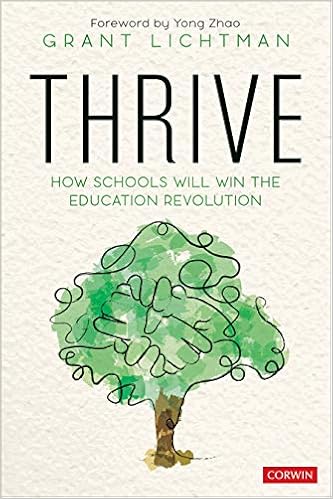
Grant defines innovation in this way, including an amazing graphic from his upcoming book, THRIVE: How Schools Will Win the Education Revolution:
…value is increased when students learn better. Therefore, changes in practice that result in better learning are innovative and those that don’t are not.
One quick question is, How do we know when students learn better? How are we measuring the effect size of the innovations, these changes in practices that allegedly result in better learning? I’m not sure that Grant Lichtman’s response answers that question.
After all, haven’t we been trying out stuff in schools and saying students will learn better? So much so that parents in Baltimore Public Schools are pushing back according to this Wall Street Journal article? One of the parents, Dr. Boyd who is a professor of medicine at Johns Hopkins, says, “I feel like my kids have been part of a huge massive experiment I have no control over.”
Info On Effect Size
 |
| Watch George Lilley explain it (read blog) |
Let’s take a moment to revisit Grant’s points.
Technology Backlash
One of the challenges that we face in schools today is the backlash against technology due to low student achievement. You can read my blog entry, Banning Technology, which cites a lot of the research that has led to this.
Or, you could read Mike Schmoker’s September, 2019 article in ASCD’s Educational Leadership. After reading these articles, it would be easy (careful) to jump to the conclusion that we should ban technology. It simply does NOT work as it has been implemented, and we should be “focusing on the essentials.”
The ubiquity of these poor practices is made evident by decades of classroom observation research (Darling-Hammond, 2010; Good & Brophy, 1997). They amount to “hundreds of hours of wasted class time” every year, in the great majority of schools (Kane & Steiner, 2019). For researchED’s Eric Kalenze (2014), these findings constitute an educational system that is “upside down”—in which the most potent, proven practices are the least implemented, even as ineffective, time-wasting practices are astonishingly common. (Source: Mike Schmoker)
To focus on essentials, Schmoker says, THREE things must be in place:
- Clear, coherent curriculum (a.k.a. guaranteed and viable curriculum (GVC) a la Marzano)
- Sound instruction
- Authentic literacy (reading, discussion and writing)
Seems simple, eh? It’s so seductive to simplify. Some would say its easier to just do those 3 things and improve student achievement.
Should we be wasting our money on untested, “unproven” innovations?
When Technology Is NOT An Innovation
Surprisingly, Lichtman pulls a Captain Kirk “Kobayashi Maru.” In a defining move, Lichtman points out that technology is not an innovation. He defines a 3D printer as “just a 3D printer until it is used in a way that routinely results in better learning outcomes.” How might that occur?
Building Deeper Learning Cheat Sheet
Grant Lichtman provides a Building Deeper Learning Cheat Sheet (2015) that includes how to increase student engagement, increase curiosity, build a student-centered classroom.
As I review these, I wonder how they compare to Hattie’s list of effective instructional strategies in Visible Learning and Corwin Press’ Meta X database. What’s the effect size of these specific approaches?
Grant admits he lacks the research to prove his cheat sheet strategies lead to better learning. Then he pushes back:
So you decide: wait for the 20 year longitudinal study that proves that more highly-engaged students learn better, and that each of the elements on the Cheat Sheet can contribute, or think for yourself and just do it!
A simpler approach, some may argue, is to use only those instructional strategies proven effective. John Hattie has a list. Shouldn’t that be used for the mass of students out there in classrooms whose teachers may not be using proven strategies? Why take a risk?
Ok, this is a quick reflection on Grant Lichtman’s blog entry. Definitely worth revisiting and reflecting some more. However, it’s late and I’m tired. Be sure to read ASCD’s article by Mike Schmoker and Grant Lichtman’s By Definition, Better Learning Is “Innovation…and then if you need to fall asleep, read my blog entry, Value Added Innovation. 🙂
Discover more from Another Think Coming
Subscribe to get the latest posts sent to your email.
 Another Think Coming