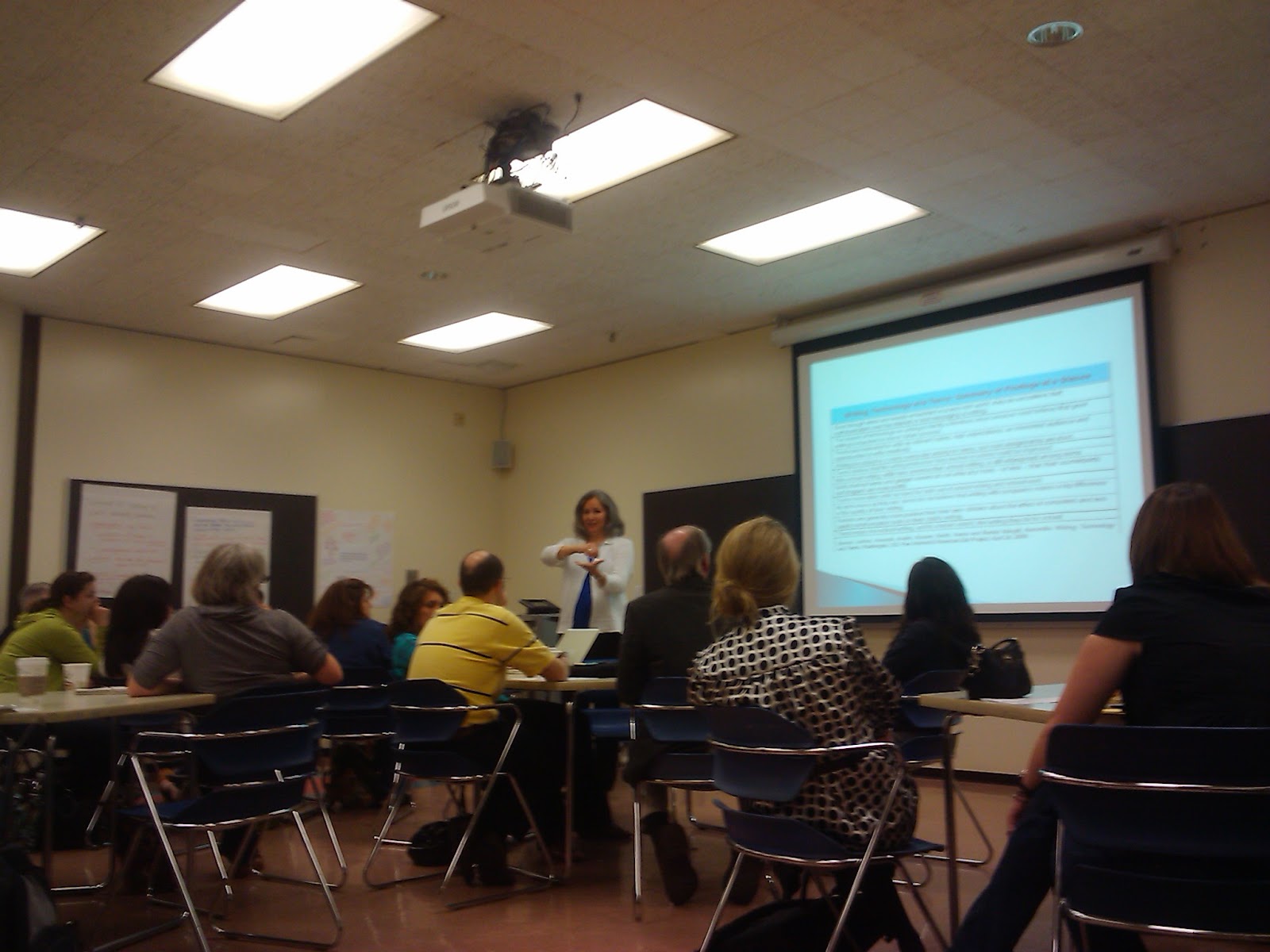
Photo taken at Heart of Texas Writing Project Conference on April 10, 2010
At the Saturday Heart of Texas Writing Project on April 10, 2010, I had the opportunity to listen to some intriguing ideas. Dr. Liz Stephens spoke on Digital Makeovers for Writing Lessons.
Below are my hastily scribbled notes (I was trying to recapture the writing on paper experience which slows processing down enough for me to think about it rather than focus on transcribing speech). Note that I have mixed in my own thoughts, and tried to italicize Dr. Stephens ideas.
How do we help teachers do something better? This was the question we asked ourselves when writing this book. Don’t throw everything out was the approach we chose. Take what is there and make it better.
Liz began with a series of news flashes (which appear in her book, BTW) that highlighted how technology is changing how we communicate and interact. She then pointed out the difference between the “Old Bloom’s Taxonomy” and the “New Bloom’s” which moves from nouns to verbs, meaning a focus on doing and “more action.”
What does this mean for teachers? she asks the group. Tyler Gill (more on Tyler later) shares the point, “Walk a digital mile in their digital shoes.”
Liz makes an interesting point about 6th grade writers. They don’t perceive the writing they do with digital devices–texting, digital storytelling, tweeting, facebooking–as “writing.” The definition of “writing” for them is that writing happens in school.
One of the questions from the audience was, “Are students better at ‘creative writing’ than expository writing?” If they are, it is probably because that is what many focus on. That’s why I like Tony Stead’s work on the importance of teaching non-fiction writing so much. You can listen to a podcast of Tony I recorded some time ago.
Another point that came up in the session was, Writing needs to be cross-curricular and equipment needs to be there. School districts have to be supportive of various technologies. The general sentiment in the room was that school districts are NOT supportive, which led Liz to mention cell phones, in particular Liz Kolb’s book (but no mention of her blog). The use of mobile devices–cell phones–are a valuable tool that we’re missing.
Liz points out that we’re all familiar with the writing process. She represents it in this way:
writing process = stages
writing process + digital tools = frames
The frames involve composing with words, images, sounds, music, animation, video, web links, and more. The frames include inside writing, responsive writing, purposeful writing (and social action which she didn’t include in her presentation). These are frames of mind from which a digital native…
I wanted so much to quote Jamie McKenzie’s objections to Prensky’s concept of digital natives. It seemed that everyone that I heard speak about this had bought into the idea, and I wanted to be oppositional. Terrible! (smile)
Liz goes on to share a brief description of the different frames:
Inside Writing: Learner thinks about the topic and researches it. Aren’t you composing when you search in Google and gather information? You don’t have a planner or conceptual map. You’re doing it all in your head.
Responsive Writing: When the writer shares what she initially drafts with others.
Purposeful writing: The writer revises and edits to be sure the audience for for the piece will be satisfied and/or informed.
Social Action Writing: When the written piece is published with the intention of promoting change in the community.
The rest of the session involves some discussion on remaking lessons and how those appear in the book. Remaking ideas included making changes to good lessons by adding the following:
- Video
- Concept map
- Google search or wikipedia
- Blog
- Web site
- Put more priority on higher-order thinking than high stakes testing
- Class stratification is what is going on now in schools
- The video made some people feel old, like they just couldn’t keep up, a sentiment that came out later during one of the presentations.
- Enormous gap in paper-n-pencil world. Gigantic cultural differences
- No natural light, few people interacting
- Don’t want to be in the world portrayed by the video. There appeared to be a breakdown in communication (face to face, as opposed to technology-mediated)
- Someone responded to that last feedback with the point that technology provided opportunities to communicate in ways that brought people closer together instead of separating them…some of the people in the video were seen to be collaborating/communicating a world apart.
- Cost and accessibility made this vision difficult to realize.
- There needs to be a balance–it’s important we, as people, need to be present in the moment. It was hilarious when this was shared because the person making the point had her phone go off, calling into question her assertion that she was in the moment.
- Increased technology doesn’t mean you lose the other (face to face interactions)
- As an educator, there is a feeling of anxiety. Running the race…and getting behind. I don’t have the resources (as a teacher) to get caught up or make the investment.
- “It’s only technology to those born before it.” Tyler Gill
 Subscribe to Around the Corner-MGuhlin.org
Everything posted on Miguel Guhlin’s blogs/wikis are his personal opinion and do not necessarily represent the views of his employer(s) or its clients. Read Full Disclosure
Discover more from Another Think Coming
Subscribe to get the latest posts sent to your email.
 Another Think Coming